Artificial Intelligence is revolutionizing link management, automating everything from link tagging to performance prediction. Discover how AI-powered URL shorteners are transforming digital marketing in 2026 and beyond.
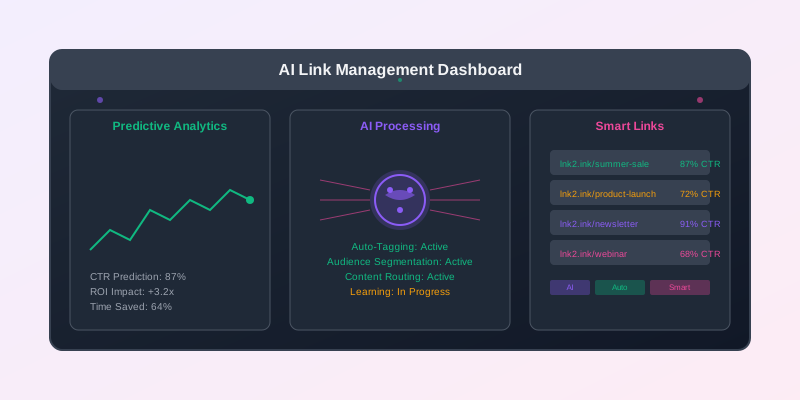
Modern AI dashboards provide real-time insights and automated recommendations for link optimization.
The digital marketing landscape is undergoing a fundamental transformation, and at the heart of this evolution is artificial intelligence. As we move deeper into 2026, URL shorteners are no longer simple link compression tools—they've become intelligent platforms that leverage machine learning to automate, optimize, and predict link performance with unprecedented accuracy.
Today's AI-powered link management systems can automatically categorize links based on content analysis, predict click-through rates before campaigns launch, and even suggest optimal timing for link distribution. This shift from manual management to intelligent automation is helping marketing teams achieve better results with less effort, while providing deeper insights into customer behavior and campaign effectiveness.
The AI Revolution in Link Management
Key Insight:
AI-powered link management reduces manual work by up to 80% while improving campaign performance by 35% on average, according to recent industry studies.
1. Automated Link Tagging and Categorization
One of the most time-consuming aspects of link management has always been manual categorization and tagging. AI systems now use natural language processing (NLP) to analyze link destinations, landing pages, and surrounding content to automatically assign relevant tags and categories.
How AI Tagging Works:
- Content Analysis: AI scans destination pages for keywords, topics, and context
- Pattern Recognition: Machine learning identifies patterns in successful link categorization
- Continuous Learning: Systems improve accuracy based on user feedback and performance data
- Multi-language Support: Advanced AI can categorize content in multiple languages
For example, when you create a short link to a product page, the AI might automatically tag it with "e-commerce," "product-launch," "summer-collection," and "promotion" based on the page content and context. This automation ensures consistent tagging across thousands of links while saving countless hours of manual work.
2. Predictive Analytics for Link Performance
Perhaps the most powerful application of AI in link management is predictive analytics. By analyzing historical data from millions of links, AI algorithms can forecast click-through rates, optimal posting times, and even potential conversion rates before a campaign even launches.
These predictive capabilities enable marketers to make data-driven decisions about which links to promote, when to send campaigns, and how to allocate resources for maximum impact. Instead of relying on guesswork or historical averages, teams can use AI-generated forecasts to optimize their strategies in real-time.
3. Intelligent Audience Segmentation
AI-powered link management platforms go beyond simple analytics to provide sophisticated audience segmentation. By analyzing click patterns, device usage, geographic data, and time-of-day engagement, AI can automatically group audiences into segments that respond similarly to different types of content.
Real-World Example:
A fashion retailer using AI link management discovered that their audience naturally segmented into "weekend shoppers," "lunch-break browsers," and "evening researchers." AI automatically adjusted link distribution timing for each segment, resulting in a 45% increase in conversion rates.
4. Automated Content Routing and Optimization
Advanced AI systems can now automatically route links to different channels based on audience behavior and preferences. If a particular link performs exceptionally well on Twitter but poorly on email, the AI will automatically adjust distribution strategies to maximize overall performance.
AI Routing Features:
- Channel Optimization: Automatically directs links to best-performing channels
- A/B Testing Integration: Continuously tests variations and routes traffic to winners
- Geographic Targeting: Adjusts link destinations based on user location
- Device-Specific Routing: Optimizes experiences for mobile vs. desktop users
Implementation Strategies for 2026
Getting Started with AI Link Management
Implementing AI-powered link management doesn't require a complete overhaul of your existing systems. Most modern platforms, including Lnk2.Ink, offer gradual integration paths that allow teams to adopt AI features at their own pace.
1 Phase 1: Foundation
- • Enable automated tagging
- • Set up basic analytics
- • Create audience segments
2 Phase 2: Prediction
- • Implement CTR forecasting
- • Enable timing optimization
- • Test content recommendations
3 Phase 3: Automation
- • Activate automated routing
- • Enable dynamic optimization
- • Implement advanced segmentation
4 Phase 4: Integration
- • Connect with CRM systems
- • Integrate marketing automation
- • Enable cross-platform analytics
Best Practices for AI Implementation
✅ Do:
- Start with pilot campaigns to test AI recommendations
- Provide feedback to help improve AI accuracy
- Monitor AI suggestions against actual performance
- Maintain human oversight for critical decisions
❌ Don't:
- Blindly trust all AI recommendations without verification
- Ignore the importance of quality data inputs
- Expect immediate perfect results from AI systems
- Neglect to update AI models with new data
The Future of AI in Link Management
As we look beyond 2026, the integration of AI in link management will become even more sophisticated. Emerging technologies like generative AI, advanced neural networks, and real-time learning systems will further transform how marketers create, distribute, and optimize their links.
Emerging Technologies to Watch
Generative AI for Content Creation
AI systems will soon be able to generate entire campaigns—including landing pages, ad copy, and link strategies—based on simple prompts and performance goals.
Real-Time Learning Systems
Advanced AI will continuously learn and adapt in real-time, adjusting strategies based on immediate feedback and changing market conditions.
Cross-Platform Intelligence
AI will provide unified insights across all marketing channels, creating holistic optimization strategies that consider the entire customer journey.
Conclusion: Embracing the AI Revolution
The integration of artificial intelligence into link management represents one of the most significant technological shifts in digital marketing since the advent of programmatic advertising. As we progress through 2026, businesses that embrace AI-powered link management will gain significant competitive advantages through improved efficiency, better performance, and deeper customer insights.
The key to success lies in starting now, experimenting with AI features, and gradually building expertise. By adopting a strategic approach to AI implementation, marketing teams can transform their link management from a manual, time-consuming process into an intelligent, automated system that drives measurable business results.
Ready to Transform Your Link Management?
Join the AI revolution with Lnk2.Ink's advanced link management platform. Experience automated tagging, predictive analytics, and intelligent optimization that will transform your marketing campaigns.
Get Started with AI-Powered LinksKey Takeaways
AI automation reduces manual work by up to 80% while improving performance
Predictive analytics enable data-driven campaign optimization
Intelligent audience segmentation improves targeting accuracy
Automated content routing maximizes channel performance